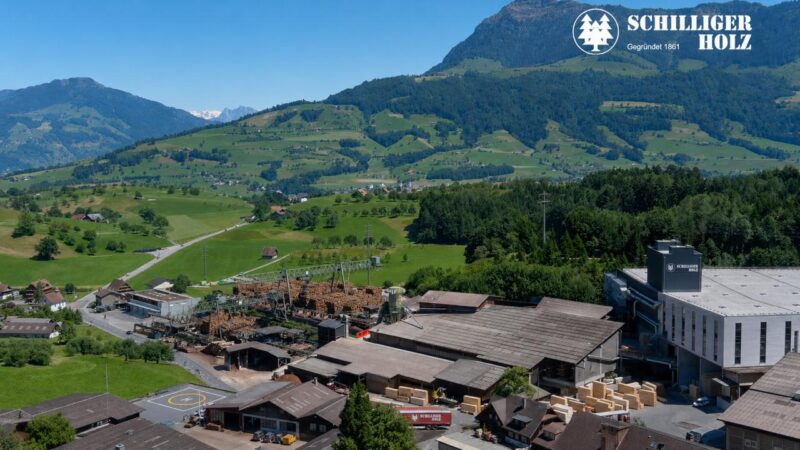
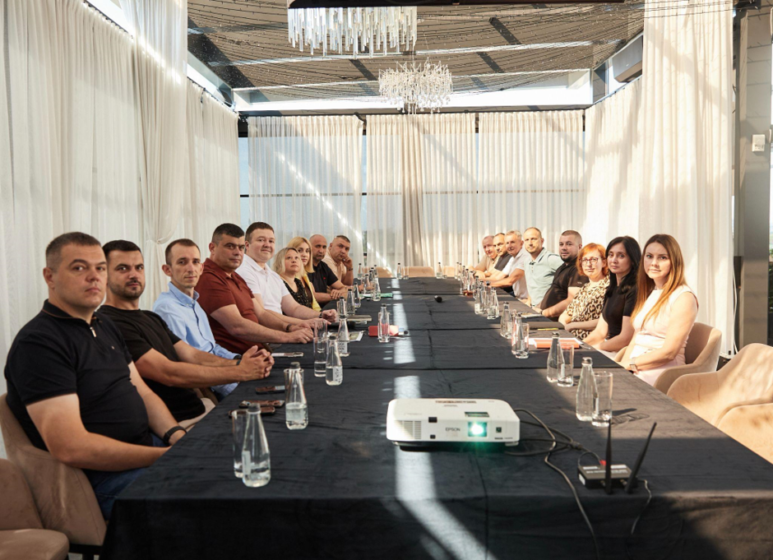
In June 2026, representatives of the Association of Woodworking Enterprises of Ukraine (AWEU) took part in events organized by the Swiss Import Promotion Programme (SIPPO) in Zurich. One of the practical parts of the programme was a meeting with the management of Schilliger Holz AG, one of Switzerland’s largest wood-processing companies.
The company presentation was delivered by Ernest Schilliger, a representative of the owning family and the company’s head. During the meeting, participants learned about the company’s history, production capacities, main areas of activity, and its vision for the future of timber construction in Europe.
From a Sawmill to an International Group
The history of Schilliger Holz began in Switzerland in 1861. The company has remained a family-owned business for more than 160 years and is now managed by the fourth generation of the Schilliger family.
Over this period, the company has evolved from a traditional sawmilling operation into one of the most integrated wood-processing businesses in the region. Today, the company’s activities extend beyond Switzerland to France, where the group also operates production facilities.
Production Scale
The Schilliger Holz Group employs more than 300 people.
Its core activity is the processing of softwood and the production of materials for the construction sector. According to open sources, the group’s production capacities allow it to process more than 500,000 m³ of roundwood annually.
The company’s largest production site is the plant in Volgelsheim, France, with an estimated capacity of around 300,000 m³ of timber per year. The second key asset is the company’s facility in Küssnacht, Switzerland.
Focus on Added Value
Unlike traditional sawmilling companies, Schilliger Holz has actively developed advanced wood processing over the past decades.
The company’s main production areas include:
- sawn timber;
- structural timber;
- glued laminated timber;
- CLT panels (Cross-Laminated Timber);
- elements for timber construction;
- wood-fibre insulation materials.
The company operates in the high value-added product segment, focusing primarily on the needs of the construction sector.
The Role of Timber Construction
One of the central topics of the presentation was the development of timber construction in Europe.
According to the company’s representatives, demand for modern timber structures has become one of the key drivers of investment in the production of CLT and other engineered wood products.
In many EU countries, timber is viewed as a tool for decarbonising the construction sector, creating additional demand for advanced wood-processing products.
Full Use of Raw Materials
Schilliger Holz pays particular attention to the use of by-products from wood processing.
The company consistently implements the principles of the circular economy, aiming to use wood raw materials as efficiently as possible. Processing by-products are used to produce new materials and to meet the energy needs of the company’s facilities.
This approach helps improve the economic efficiency of production and reduce resource losses.
What the Experience of Schilliger Holz Shows
The history of Schilliger Holz demonstrates one of the typical development paths of the wood-processing industry in Western Europe.
Over recent decades, the company has consistently moved away from selling raw materials and basic sawn timber towards the production of higher value-added products. Today, its key areas of development include engineered wood, timber construction, energy-efficient materials, and the comprehensive use of resources.
These are precisely the segments that now form the basis of competitiveness for many leading European wood-processing companies and define the future direction of the industry.